
Welcome to our weekly newsletter where we share some of the major developments on the future of cybersecurity that you need to know about. Make sure to follow my LinkedIn page as well as Echelon’s LinkedIn page to receive updates on the future of cybersecurity!
To receive these and other curated updates to your inbox on a regular basis, please sign up for our email list here: https://echeloncyber.com/ciw-subscribe
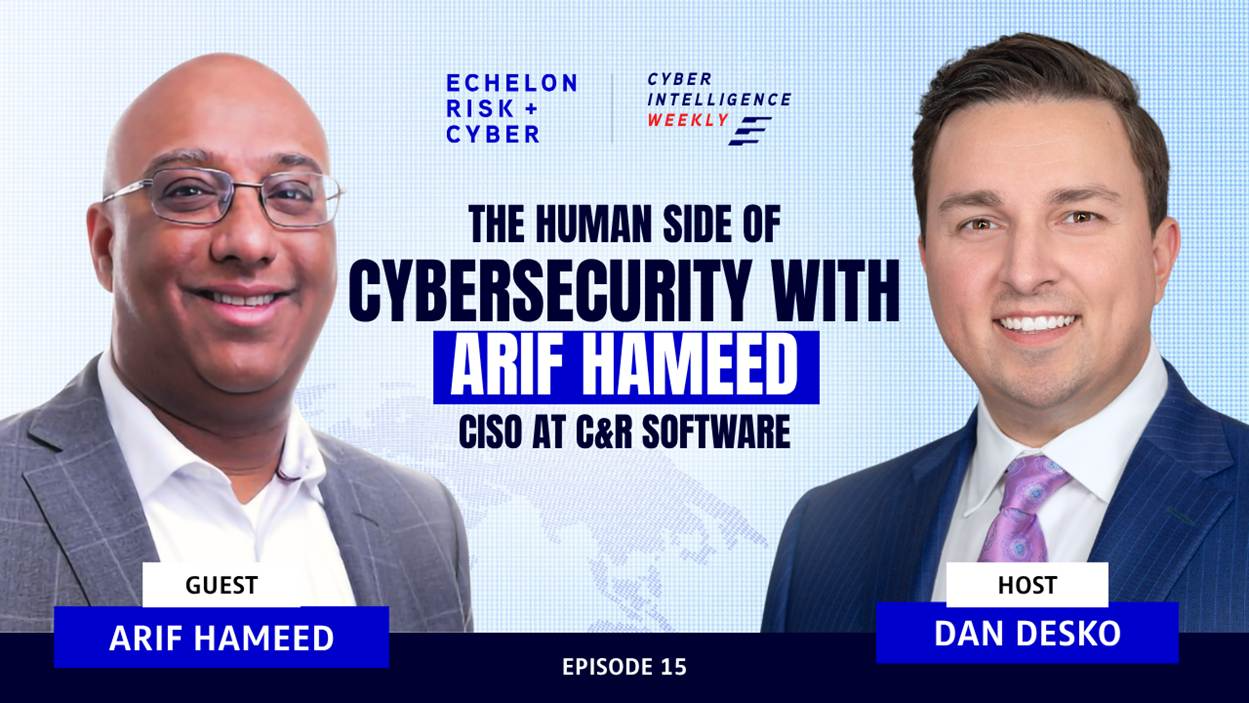
Before we turn to this week’s edition of Cyber Intelligence Weekly, I want to introduce a new Personal Spotlight Series: The Human Side of Cybersecurity.
This series is grounded in conversation rather than commentary. It centers on CISOs and other cyber leaders who are in the seat—navigating real leadership pressure, complex risk decisions, and the human realities of building and sustaining security programs. Some are earlier in their journey, others further along paths many of you may recognize or aspire toward. What they share isn’t theory. It’s experience—earned through moments of progress, frustration, growth, and reflection. These conversations are for the professionals who show up every day to quietly carry the weight of this industry.
Arif Hameed — “Understand the business and how cybersecurity supports the overall mission.”
In this episode, I sat down with Arif Hameed, a seasoned cybersecurity leader whose career has spanned software quality assurance, IT audit, business information security, third-party cyber risk, customer trust, and multiple CISO roles. What makes Arif’s story especially relatable is that his path into cybersecurity was not linear. He started with a computer science degree in Toronto, realized software development was not the right fit, and began in QA, where he discovered he had a knack for spotting problems. From there, a combination of curiosity, career pragmatism, and strong timing led him into IT audit through ISACA and the CISA, which became the foundation for everything that followed.
What stood out most in our conversation was how clearly Arif understands that cybersecurity leadership is about far more than technical skill. A major turning point for him came during his time at Equifax Canada, where he helped rebuild customer trust, restore certifications, manage difficult customer audits, and work directly with sales and executive teams in the aftermath of a major corporate crisis. That experience gave him a broader view of what security means to a business. He saw firsthand that security is not just a control function—it is deeply tied to revenue, customer confidence, and strategic growth. That was the point where the CISO role became the obvious next step.
He also shared an important lesson from his first CISO role: leading with fear, uncertainty, and doubt does not work. Early on, he pushed a message centered too heavily on issues and gaps, and it did not resonate. He had to step back, better understand the business context, and reposition the conversation in a way that aligned security with the organization’s real priorities. That lesson clearly stuck. Throughout the discussion, Arif kept coming back to the same idea: security leaders have to translate risk into business terms, adjust to the environment they are in, and communicate in a way that drives action rather than resistance.
Additional takeaways from the conversation:
- IT audit can be a phenomenal entry point into cybersecurity. It gives professionals a strong grounding in controls, risk, and how organizations actually operate.
- Some of the best cyber careers are built through smart pivots. Arif moved from QA to audit to risk to advisory to executive leadership by staying open to new opportunities.
- A breached company can be a career-defining opportunity. Joining Equifax after the breach gave him a chance to help rebuild trust and operate at the intersection of security and business value.
- What works in one organization may fail in another. Security leaders have to adapt their style, message, and priorities to the business in front of them.
- Communication is forged in the hard moments. Early experiences getting heavily reviewed in IT audit helped him develop the precision and clarity that later became critical as a leader.
- Nation-state threats can be overemphasized for many organizations. For most businesses, fundamentals like cyber hygiene, phishing resilience, and IAM deserve more focus than headline-level APT fear.
- Automation helps protect teams. Arif is intentional about reducing repetitive work through scripting, dashboards, AI-assisted tasks, and better workflow management.
- Healthy teams need more than encouragement. Resourcing, task transparency, outside help during crunch periods, physical and mental health support, and team camaraderie all matter.
- If building a program from scratch, start with IAM, EDR, and security awareness. Those are foundational controls that support almost every environment.
- Being a CISO is not just a technical role. Business understanding, executive communication, strategy, and influence are what separate good technical practitioners from effective CISOs.
- Optics and relationships matter. Even small things—like smiling in team photos or turning cameras on in meetings—help reinforce that security is there to collaborate, not intimidate.
His billboard message for every aspiring CISO was simple and direct: Understand the business and how cybersecurity supports the overall mission. That line captures his leadership philosophy perfectly. The job is not to obsess over risk in a vacuum. It is to understand what matters to the business, explain the “so what,” and help the organization move forward securely.
If there was one thread that defined this conversation, it was this: the strongest security leaders do not just know controls. They know how to connect controls to trust, trust to business value, and business value to action.
Watch the Full Interview Here: https://www.youtube.com/watch?v=aBhZ9tpXOPg
Echelon Events & Thought Leadership Highlight
Just 3 days away!
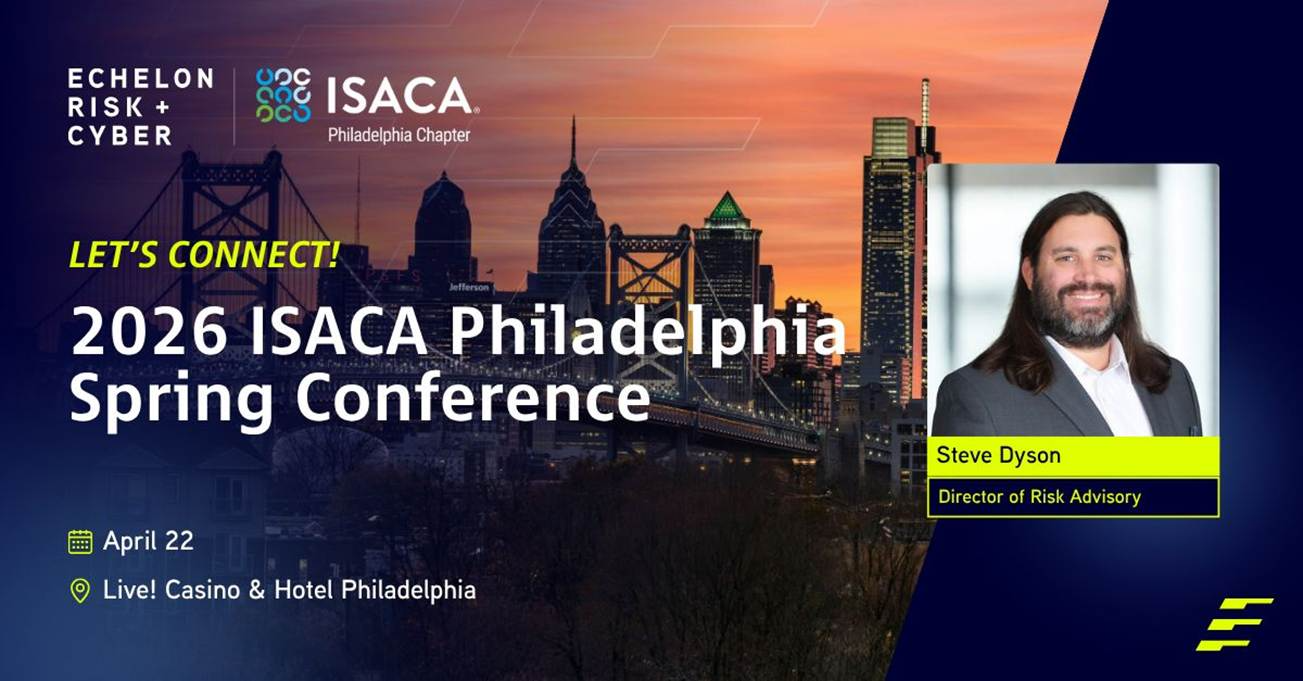
The ISACA Philadelphia Spring Conference is coming up on April 22.
Stephen Dyson will be speaking on how organizations can align security operations with evolving regulations like the SEC Cybersecurity Rules, CMMC, and DORA using frameworks such as the Cyber Defense Matrix and MITRE ATT&CK. If you’re attending, let's connect!
More Info: https://web.cvent.com/event/56454202-4602-4f98-8eac-d4d158c7b7da/summary
Away we go!
1. April Patch Tuesday Delivers a Harsh Reminder: Patch Velocity Matters More Than Ever
April’s Patch Tuesday was not routine. Microsoft’s release was one of its largest on record, with security researchers counting 163 Microsoft CVEs, while broader tallies that include Chromium and other third-party items push the total well past that figure. More important than the volume was the mix: an actively exploited SharePoint flaw, a publicly disclosed Windows Defender privilege escalation bug known as BlueHammer, multiple critical remote code execution issues, and a heavy concentration of browser-related fixes.
The highest-priority Microsoft item is CVE-2026-32201, an actively exploited SharePoint Server spoofing vulnerability. Security analysts warn that flaws in this category can be used to present falsified content inside trusted SharePoint environments, creating opportunities for phishing, data manipulation, and follow-on compromise. Microsoft also patched CVE-2026-33825, the Windows Defender issue known as BlueHammer, after public exploit code surfaced. On top of that, two other Microsoft flaws stand out for defenders because they carry wormable characteristics in the right conditions: CVE-2026-33827 in Windows TCP/IP and CVE-2026-33824 in the Windows Internet Key Exchange service.
Outside the Microsoft ecosystem, Google fixed its fourth Chrome zero-day of 2026, CVE-2026-5281, a use-after-free flaw in Dawn that affected Chrome before version 146.0.7680.178. Adobe also issued an emergency update for Acrobat and Reader to fix CVE-2026-34621, a critical bug that Adobe says is being exploited in the wild and could lead to arbitrary code execution when a user opens a malicious PDF. That combination matters because it reinforces a broader reality: endpoint compromise is still being driven by the basics, namely browsers, document readers, collaboration platforms, and the human behaviors attached to them.
There is a bigger strategic takeaway here as well. Multiple industry observers are now openly connecting the surge in vulnerability volume to expanding AI-assisted bug discovery. Whether that proves to be the primary driver or not, defenders should assume the pace of findings will continue to rise. For organizations, that means patch management can no longer be treated as a monthly hygiene exercise. It has to function like an operational discipline, with rapid prioritization, fast testing, and aggressive deployment for internet-facing systems and commonly abused user applications.

Third-Party Cloud Platforms Are Becoming the New Front Door for Breaches
A major lesson from this week’s Los Angeles City Attorney breach is that sensitive data does not need to sit inside your primary environment to create serious risk. In this case, unauthorized access reportedly occurred through a third-party digital storage or discovery transfer platform rather than internal government systems. That distinction matters technically, but not operationally. The result was still the exposure of sensitive records tied to law enforcement and legal matters.
This pattern is becoming more common across industries. Organizations often invest heavily in securing their core cloud tenants while underestimating the risk introduced by SaaS tools, collaboration portals, file transfer systems, legal platforms, and vendor-managed applications. These environments may contain regulated data, privileged workflows, or years of archived records, yet they frequently receive less monitoring and weaker access governance.
Immediate Actions for Security Teams
- Inventory all SaaS and cloud platforms storing sensitive data
- Enforce MFA and conditional access across third-party applications
- Review vendor admin privileges and external sharing permissions
- Reduce data retention in file sharing and case management systems
- Enable audit logging and alerting for mass downloads or unusual access
- Validate that third-party platforms are included in incident response plans
- Conduct periodic third-party security assessments and contract reviews
Real-World Takeaway
Your cloud security perimeter now includes every external platform that stores or processes your data. If a vendor system holds sensitive information, it should be governed with the same rigor as your primary cloud environment.

2. Why Every CISO Needs a Mythos-Ready Security Program
The new Cloud Security Alliance briefing on the “AI Vulnerability Storm” does not read like hype. It reads like a warning shot for security leaders who already feel their teams are struggling to keep up. The paper argues that AI driven vulnerability discovery has materially changed the tempo of cyber risk, compressing the time between discovery and weaponization from days or weeks down to hours. Its central message is not about one model or one vendor. It is that defenders are still operating on processes built for a slower era, while attackers are rapidly gaining machine speed advantages.
What makes the paper especially useful is that it moves quickly from diagnosis to operating guidance. The authors argue that security leaders should stop thinking of this as a temporary spike and start building a “Mythos-ready” program as a permanent capability. That means using LLM based tooling for vulnerability discovery and remediation now, updating risk metrics that were built on pre-AI assumptions, preparing for more simultaneous incidents, and doubling down on basic controls like segmentation, egress filtering, phishing resistant MFA, and defense in depth. In other words, this is not a call to panic. It is a call to modernize.
The most interesting concept in the paper may be its push for VulnOps as a long term organizational function. The idea is that vulnerability operations must become a standing discipline, staffed and automated more like DevOps, with continuous discovery, triage, and remediation across both first party and third party software. In the near term, the paper recommends aggressive action: point AI agents at your own code and pipelines, require teams to adopt AI agents in security work, defend those agents as a new attack surface, prepare for continuous patching, update business risk models, and reduce attack surface through better inventory and software discipline.
What I like most about this briefing is that it treats the human side of the problem as seriously as the technical side. The authors explicitly warn that security teams are being squeezed by rising vulnerability volume, faster release cycles, and the need to integrate AI into their own workflows without corresponding gains in headcount or breathing room. Their conclusion is clear: this is a board level issue now, and organizations that use this moment to secure funding, accelerate governance, and harden their environments will be in a far stronger position than those still debating whether the threat shift is real.

AI Coding Assistants Are Introducing a New Software Supply Chain Risk
This week’s AI security focus is on the growing use of AI-powered coding assistants and agentic developer tools. These platforms can write code, execute commands, inspect repositories, and recommend fixes in seconds. That productivity upside is real, but so is the security risk. When AI tools operate inside developer environments, they gain access to source code, secrets, terminals, APIs, and cloud-connected workflows.
Recent security incidents involving AI coding tools and related package ecosystems have shown how attackers can exploit developer trust. Malicious packages, poisoned dependencies, unsafe prompts, and manipulated configuration files can turn an AI assistant into a pathway for credential theft or unauthorized code execution. In many organizations, these tools are being adopted faster than governance controls are being established.
Immediate Actions for Security Teams
- Create an approved list of AI coding tools for enterprise use
- Require patching and version control for local AI developer tools
- Restrict access to secrets, production systems, and sensitive repositories
- Review AI-generated code through standard secure SDLC processes
- Monitor developer endpoints for unusual outbound traffic or token use
- Train developers on prompt injection, malicious packages, and config risks
- Log and govern AI tool usage just like any other privileged software
Real-World Takeaway
The next major AI security issue may not come from a chatbot. It may come from a trusted coding assistant running on a developer laptop with access to your most valuable systems.

3. London Healthcare Still Feeling Impact of Ransomware Attack Nearly Two Years Later
Nearly two years after the Synnovis ransomware attack first hit hospitals across South East London, the story is no longer just about a cyber incident. It is about what happens when critical healthcare systems remain impaired long after the headlines fade. New reporting shows at least one NHS trust is still operating without fully restored pathology systems, relying on paper workflows, manual uploads, and phone calls for urgent results. For clinicians, that means information is slower to reach the bedside. For patients, it means delays, uncertainty, and higher operational risk.
The June 2024 attack disrupted blood testing across the region, forcing canceled surgeries, postponed appointments, and treatment delays. It also strained blood supplies badly enough that officials warned only the most urgent transfusions might be prioritized if conditions worsened. The incident, attributed to the Qilin ransomware group, reportedly included the theft and publication of sensitive patient data affecting nearly one million people. Some of the exposed records allegedly involved highly personal medical conditions, adding a privacy crisis to an already serious care disruption.
What makes this case especially important is the evidence of lingering downstream effects. At South London and Maudsley NHS Foundation Trust, internal disclosures indicate pathology systems still had not been fully restored as of early 2026. More than 161,000 pathology reports were reportedly delayed in being entered into patient records, while the trust logged over 100 patient safety incidents tied to missing, delayed, or incorrect results. One separate case at King’s College Hospital recorded a patient death in which the cyberattack was considered a contributing factor, underscoring how digital outages can ripple into real-world clinical consequences even when direct causation is difficult to prove.
There is a broader lesson here for every healthcare organization. Cyber resilience is not simply about preventing ransomware. It is about maintaining safe operations when prevention fails. Hospitals and health systems should treat business continuity, manual fallback procedures, vendor concentration risk, incident communications, and recovery testing as core patient safety controls. The Synnovis incident is a reminder that in healthcare, cybersecurity failures are rarely confined to IT. They can echo through care delivery for months or even years.
Thanks for reading!
About us: Echelon is a full-service cybersecurity consultancy that offers wholistic cybersecurity program building through vCISO or more specific solutions like penetration testing, red teaming, security engineering, cybersecurity compliance, and much more! Learn more about Echelon here: https://echeloncyber.com/about