
Welcome to our weekly newsletter where we share some of the major developments on the future of cybersecurity that you need to know about. Make sure to follow my LinkedIn page as well as Echelon’s LinkedIn page to receive updates on the future of cybersecurity!
To receive these and other curated updates to your inbox on a regular basis, please sign up for our email list here: https://echeloncyber.com/ciw-subscribe
Cyber Intelligence Weekly
The Human Side of Cybersecurity is back for Season 2!
For those new to the series, this is a podcast where I sit down with CISOs and security leaders who are in the seat, navigating real leadership pressure, complex risk decisions, and the human realities of building and sustaining security programs. What they share is experience, earned through moments of progress, frustration, growth, and reflection.
Last season, 15 conversations across industries pointed to the same truth: the human side of this work is what actually moves the needle. Season 2 goes deeper into exactly that, and we are keeping it rolling with conversations I think you'll really enjoy.
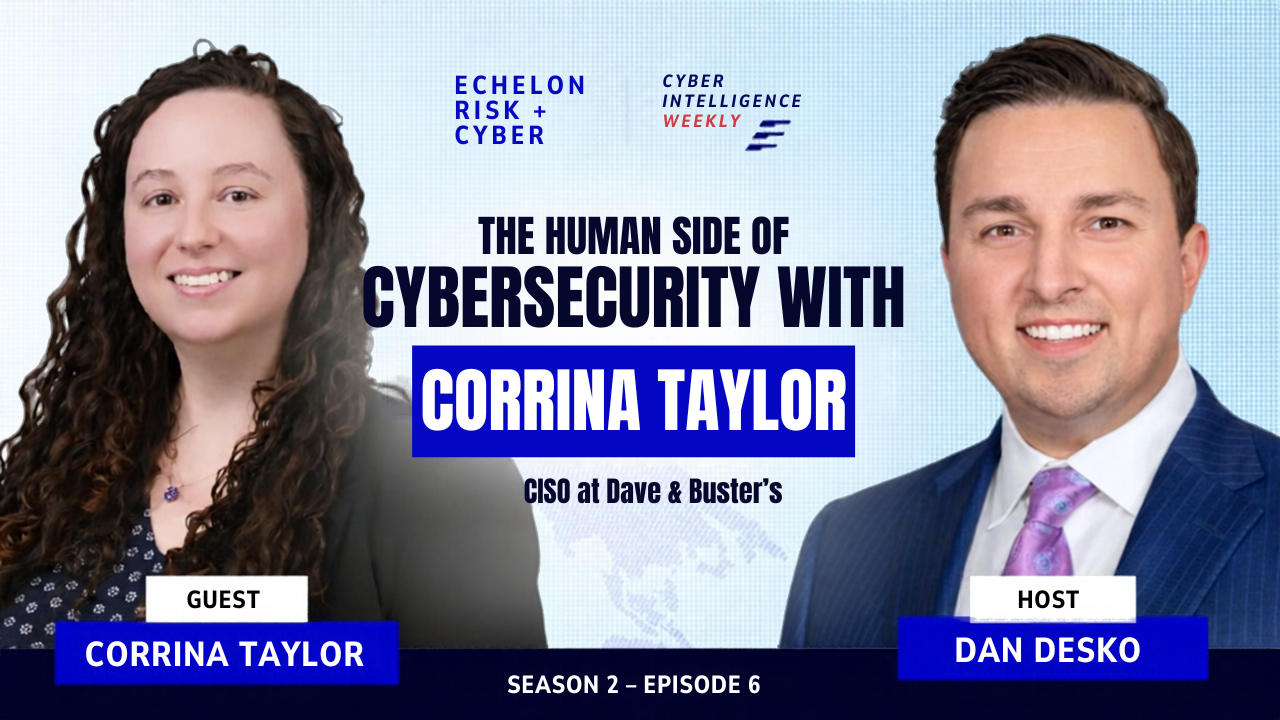
Corrina Taylor (Dave & Busters, Inc.) — “Being right isn’t enough. You have to bring people with you.”
In this episode, I sat down with Corrina Taylor, CISO at Dave & Buster's Inc., whose path into cybersecurity started with one of the better accidental career stories I’ve heard on this series. She applied for what she thought was an internship at Paycom, walked into a full-time analyst role. From that job, she built a vulnerability management program from scratch, later became the first dedicated security hire at Wingstop, led global security at PRG, and eventually landed at SMU to protect one of the most layered and complex environments any CISO can inherit.
What stood out most was how clearly Corrina connects the people side of security to the operational side. She described an 18-hour incident call with her team at PRG, being exhausted and stressed, but what she remembers most is that they could still crack jokes. That moment crystallized something for her about why culture matters. The trust you build before an incident is what carries you through the incident.
She also brought one of the sharpest takes on AI governance I’ve heard on the show. Her framing: the industry is simultaneously overreacting to AI and underestimating it. Overreacting by treating every AI security challenge as entirely new when the fundamentals still apply. Underestimating it by thinking a policy and a blocked website actually addresses the exposure.
Additional takeaways from the conversation:
- Trust has to be built before the incident, not during it. The relationships that carry a team through a 2 a.m. call are built during the normal days.
- Patch everything immediately is not a strategy. The Meltdown and Spectre response taught her to slow down, test, and share responsibility across teams instead of charging ahead alone under pressure.
- Cultural nuance is part of communication. A global communication sent in the wrong dialect can be more damaging than no communication at all. Corrina learned that lesson at PRG and now thinks carefully about not just what she says, but how it will land for the specific person or region receiving it.
- Build guardrails, not walls. AI is already embedded in tools, platforms, and development environments whether security approved it or not. The useful question is how to let people use it safely, not whether to stop them.
- People first, identity second, visibility third. If Corrina were rebuilding a program from scratch, that is the order of investment. The best technology fails without the right people implementing it. Identity governs access to everything, and when something gets through, visibility determines how fast you can respond.
Her billboard message was one of my favorites from this entire season: Being right isn’t enough. You have to bring people with you. Early in her career, being technically correct was rewarded. In leadership, she learned that a perfectly identified vulnerability goes nowhere without trust, funding, and the right people aligned behind the solution. Correctness without influence is just noise.
If there was one thread that ran through this conversation, it was this: the security leaders who build programs that last are the ones who earn trust before they need it, communicate in terms that make sense to the people across the table, and understand that the human side of this work is not separate from the technical side, it is the foundation of it.
Watch the Full Interview Here: Human Side of Cybersecurity | Linktree
Echelon Events & Thought Leadership Highlight
Did you know that 69% of large U.S. enterprises say they have a fully unified AI governance policy, however, 47% admit they’ve bypassed their AI governance processes to push through an urgent deployment.
If a policy gets skipped when the pressure is on, is it really governance or just documentation?
A written policy tells employees what to do. Visibility, access controls, and monitoring tell you whether they actually did it.
Two questions worth bringing to your next leadership conversation:
1️⃣ Do we know where AI is operating?
2️⃣ Can we prove our controls work?
Read the full article from @Josh Fleming and @Stephen Dyson: https://lnkd.in/eAf33NWs

Away we go!
1. Microsoft 365 Outage Disrupts Businesses Worldwide and Raises Questions About Cloud Resilience
Microsoft experienced one of its most significant service outages in recent years after a technical failure disrupted Microsoft 365 services for businesses and government organizations around the world. The incident began on November 12, affecting Outlook, Exchange Online, Microsoft Teams, SharePoint, Copilot and other services that millions of employees rely on daily. The disruption lasted more than 24 hours, with Microsoft confirming broad service restoration by November 14. According to outage monitoring service Downdetector, users submitted more than 7.4 million reports worldwide. What initially appeared to be another temporary cloud disruption quickly became a major business continuity problem, preventing employees from accessing email, joining meetings and using critical workplace applications.
The operational consequences extended across multiple industries. Government organizations, financial institutions, healthcare providers and transportation companies reported disruptions to normal business activities. In the United Kingdom, the National Health Service and Metropolitan Police experienced service issues, while financial firms in Asia encountered difficulties processing communications and confirming transactions. Some organizations turned to alternative communication methods, including fax machines, to continue operating. Microsoft eventually traced the incident to a technical problem involving an earlier network capacity upgrade that surfaced following a subsequent network change. The issue caused requests to accumulate until affected servers exhausted their processing capacity. Microsoft emphasized that the outage was not caused by a cyberattack or malicious AI activity.
The incident illustrates a growing challenge for organizations that have consolidated critical business functions onto a small number of cloud platforms. Microsoft 365 provides enormous benefits in productivity, collaboration and centralized administration, but the same integration that makes it valuable can also create significant operational dependencies. Consider a company that relies entirely on Outlook for customer communications, Teams for internal coordination and SharePoint for accessing essential documents. When those services become unavailable simultaneously, employees may struggle to execute even routine business processes. For regulated businesses, service disruptions can also interfere with time-sensitive reporting, customer support and operational decision-making. The security of a cloud platform matters, but so does the organization's ability to continue functioning when that platform is unavailable.
Organizations should use the outage as an opportunity to evaluate their business continuity and disaster recovery plans, paying particular attention to technology dependencies that could create widespread disruption. IT and security leaders should identify critical workflows that rely exclusively on Microsoft 365, establish alternative communication channels and ensure employees know how to access emergency procedures when normal collaboration tools are unavailable. Businesses should also review their reliance on cloud identity services, third-party integrations and other technologies that may become inaccessible during a major provider outage. Regular tabletop exercises can help reveal operational gaps before a real incident occurs. The lesson is that moving infrastructure to the cloud does not eliminate downtime risk. It changes where that risk lives, and organizations still need a plan for what happens when their most trusted technology providers experience an outage.

Cloud Security Corner: AWS Vulnerability Could Expose Sensitive Cloud Logs to Unauthorized Users
Amazon Web Services has disclosed a security vulnerability that could allow attackers to access sensitive log files from Amazon EMR, the company's cloud-based big data processing service. The flaw, tracked as CVE-2026-127119, affects versions 1.1.0 through 3.17.x of AWS SDK for pandas, also known as awswrangler. According to AWS's November 12 security advisory, the issue occurs when organizations create an EMR cluster without explicitly specifying where its logs should be stored. The software automatically selects a predictable Amazon S3 bucket name but fails to verify that the bucket belongs to the customer's AWS account. An attacker who registers that bucket name first could potentially receive and read log files generated by the customer's cloud workloads.
The vulnerability illustrates how a seemingly minor configuration decision can create a significant data exposure risk. Consider a financial services company using Amazon EMR to process transaction data or a healthcare organization running analytics on sensitive operational records. Its processing logs may contain job output, application errors, file paths or other information that was never intended to leave the organization's cloud environment. If an attacker controls the destination bucket, those logs could be written directly into infrastructure outside the organization's control. The attack does not require compromising the customer's AWS account. Instead, it takes advantage of a predictable storage location and the application's failure to verify ownership before sending data.
AWS has fixed the vulnerability in awswrangler version 3.18.0. Organizations using earlier versions should upgrade promptly and confirm that existing EMR configurations reference storage buckets they control. The updated library also requires the caller to have s3:ListBucket permission on the default logging bucket so it can verify ownership. For organizations unable to upgrade immediately, AWS recommends explicitly specifying an S3 log destination owned by the organization or creating the expected default bucket within the correct AWS account and region. Administrators should also review historical EMR jobs, check for unexpected logging destinations and investigate whether sensitive information may have been written to an externally controlled bucket.
The broader lesson extends beyond Amazon EMR. Cloud applications frequently create storage resources, service accounts and logging destinations automatically, and those defaults can introduce security risks when ownership is assumed rather than verified. Organizations should establish approved logging destinations, enforce least-privilege access and periodically validate where sensitive operational data is being stored. In cloud security, protecting your data means verifying not only who can access it, but also where your applications are sending it.

2. Hackers Exploit N-able Security Flaws, Compromising Servers Even After Emergency Updates
A series of newly disclosed vulnerabilities in N-able's N-central remote monitoring and management platform has created a serious security concern for managed service providers and enterprise IT departments. On November 12, attackers began exploiting a vulnerability chain known as 4EverAble2Shell, which can allow an unauthenticated attacker to execute commands with root-level privileges on vulnerable N-central servers. The attacks followed the public disclosure of numerous security weaknesses earlier in the week and the release of emergency patches from N-able. Security researchers subsequently identified at least 21 compromised N-central servers being used for cryptocurrency mining, including 19 systems running the company's latest Hotfix 2 update. The findings demonstrate how quickly attackers can capitalize on newly published vulnerabilities, particularly when vulnerable management systems are accessible from the internet.
The security concerns intensified after researcher Sean Bales publicly released additional exploit techniques, including 4EverAble2Shell and Agent2Shell. The first targets N-central servers configured with an enabled Legacy API, while the second raises concerns about attacks against managed Windows agents. N-able had already released Hotfix 2, build 2026.4.1.26, on November 10 to address several critical vulnerabilities, but the newer attack techniques demonstrated that additional protections were necessary. Investigators observed malicious activity beginning within hours of the latest exploit disclosure. The attackers primarily deployed XMRig cryptocurrency mining software, using compromised servers to generate cryptocurrency without authorization. Although the observed attacks focused on cryptojacking, the underlying ability to execute commands with elevated privileges creates the potential for much more damaging activity.
What makes this incident particularly concerning is the privileged position remote monitoring and management software occupies within an organization's technology environment. N-central allows IT administrators and MSPs to monitor endpoints, deploy software, execute scripts and manage systems across multiple customer networks. An attacker who gains control of that infrastructure could potentially abuse the same administrative capabilities to target additional systems. Consider an MSP responsible for supporting dozens of companies. A single compromised management server could provide attackers with an opportunity to reach numerous customer environments, depending on the configuration and available privileges. There is no indication that the 21 reported compromises resulted in widespread downstream customer breaches, but the potential exposure explains why remote management platforms are attractive targets.
N-able is urging customers to install Hotfix 2, verify that the Legacy API is disabled and follow its latest guidance for upgrading agents and probes. Disabling the Legacy API is especially important because the newly disclosed exploit chains depend on that non-default configuration. The company has implemented additional protections for hosted environments and temporarily disabled certain integrations while developing further remediation, including a planned Hotfix 3. Organizations should review the vendor's published indicators of compromise, investigate unusual processes or network connections, and examine N-central systems for unauthorized activity. Any server showing evidence of successful root-level exploitation should be treated as fully compromised rather than simply patched and returned to service. The larger lesson is that the tools organizations trust to manage and secure their technology can become some of their most dangerous points of exposure when attackers gain control of them.

AI Security Corner: IBM Patches AI Gateway Flaw That Could Let Users Bypass Security Controls
IBM has released a security update addressing a high-severity vulnerability in ContextForge MCP Gateway, an open-source platform designed to connect artificial intelligence agents with enterprise applications and services. The vulnerability, tracked as CVE-2026-110279, carries a CVSS severity score of 8.1 and affects versions 1.0.0 through 1.1.0. Disclosed on November 12, the flaw involves improper handling of authentication credentials as requests pass through the gateway to connected Model Context Protocol (MCP) servers. Under certain conditions, an authenticated user could supply a specially named HTTP header that replaces the credentials the gateway would normally use when communicating with an upstream service. This could allow requests to bypass expected identity controls and undermine the accuracy of security audit records.
Consider a company deploying AI agents to help employees retrieve information from customer relationship management systems, internal databases or business applications. The organization may use an MCP gateway to centrally manage connections and ensure that users interact with systems under the appropriate identities. If someone can override the gateway's authentication credentials, requests may be processed under an identity different from the one administrators intended. For example, a user with legitimate access to the gateway could potentially cause an upstream application to accept a different valid credential, complicating enforcement of user-specific permissions and accountability. The vulnerability does not automatically give an attacker administrator credentials, but it can undermine the controls organizations depend on to separate users, applications and agent activities.
IBM has addressed the vulnerability in ContextForge MCP Gateway version 1.1.1. Organizations running affected versions should upgrade immediately and review the authentication configurations used by their MCP connections. For environments where an immediate update is not possible, IBM recommends removing the X-Upstream-Authorization request header at the reverse proxy or API gateway before requests reach ContextForge. Administrators should also limit access to MCP endpoints to trusted networks, examine gateway logs for unexpected authentication behavior and verify that upstream services are receiving the credentials intended for each connection. These measures are particularly important where gateways connect AI agents to applications containing confidential customer, financial or operational information.
As organizations begin deploying AI agents across business functions, MCP gateways are becoming an important layer of enterprise security infrastructure. These systems do more than route requests. They help enforce the identities, permissions and boundaries under which AI agents operate. A weakness in that infrastructure can create security exposure even when the underlying AI model is functioning correctly. The lesson is that giving AI agents access to enterprise systems also means securing every component responsible for deciding whose identity those agents are allowed to use.

3. SAP Patches Four Maximum-Severity Flaws That Could Give Hackers Control of Critical Business Systems
SAP has released emergency-level security fixes addressing four vulnerabilities carrying the maximum possible CVSS severity score of 10.0, raising concerns about the security of enterprise systems that manage some of the world's most important business operations. The flaws were disclosed as part of SAP's November 10 Security Patch Day, which included 35 new security notes, four GitHub security advisories and updates to three previously released security notes. The most serious issues affect core components of SAP NetWeaver, including the Internet Communication Manager, Web Dispatcher, SAP Gateway and the SAML2 authentication service. Depending on the affected component, attackers could potentially execute malicious code, bypass authentication or gain unauthorized control of business-critical applications without first obtaining valid user credentials.
Two of the vulnerabilities, CVE-2026-76964 and CVE-2026-89126, were discovered by researchers at Onapsis and are collectively known as ICM2SHELL. The flaws involve memory corruption in the handling of WebSocket traffic by SAP's Internet Communication Manager and Web Dispatcher. Because these components process web requests and often serve as entry points to SAP systems, they can be particularly attractive targets. Researchers demonstrated that an attacker with network access to a vulnerable service could potentially execute operating system commands under the account responsible for running SAP, giving them extensive control over the affected environment. A third vulnerability, CVE-2026-89103, involves broken access controls in SAP Gateway, while the fourth, CVE-2026-120017, could allow authentication bypass through SAP's SAML2 service provider under certain configurations. Each vulnerability represents a different path to compromising systems that organizations depend on to conduct business.
The potential consequences are particularly significant because SAP applications often sit at the center of corporate financial operations, human resources, manufacturing, procurement and supply chain management. Consider a manufacturer using SAP to coordinate inventory, production schedules and supplier payments. An attacker who gains elevated access to the underlying SAP environment could potentially steal sensitive financial information, manipulate business records, disrupt production workflows or use the compromised system to access other connected applications. For publicly traded companies, disruptions or unauthorized changes to these systems may also create financial reporting and regulatory concerns. Onapsis reported that it had not observed active exploitation of ICM2SHELL at the time of its November 12 update, but the availability of working exploit demonstrations makes rapid remediation important.
SAP is urging customers to prioritize the security updates associated with the affected components, including SAP Security Notes 3778530, 3778556, 3798345 and 3849308. Organizations should work with their SAP Basis and security teams to identify vulnerable kernel versions, exposed Web Dispatchers and affected authentication configurations, then apply the appropriate patches. Internet-facing components should receive the highest priority, followed by internal systems that process sensitive business data or connect to critical applications. For the ICM2SHELL vulnerabilities, SAP has also documented temporary mitigations, including disabling WebSocket support where operationally feasible, although doing so can affect legitimate application functionality. Security teams should monitor unusual process restarts, administrative activity and unexpected system behavior while remediation is underway. When the software responsible for running a company's financial and operational processes is vulnerable, the consequences of a successful attack can extend far beyond IT and directly threaten the organization's ability to do business.
Thanks for reading!
About us: Echelon is a full-service cybersecurity consultancy that offers wholistic cybersecurity program building through vCISO or more specific solutions like penetration testing, red teaming, security engineering, cybersecurity compliance, and much more! Learn more about Echelon here: https://echeloncyber.com/about