
Welcome to our weekly newsletter where we share some of the major developments on the future of cybersecurity that you need to know about. Make sure to follow my LinkedIn page as well as Echelon’s LinkedIn page to receive updates on the future of cybersecurity!
To receive these and other curated updates to your inbox on a regular basis, please sign up for our email list here: https://echeloncyber.com/ciw-subscribe
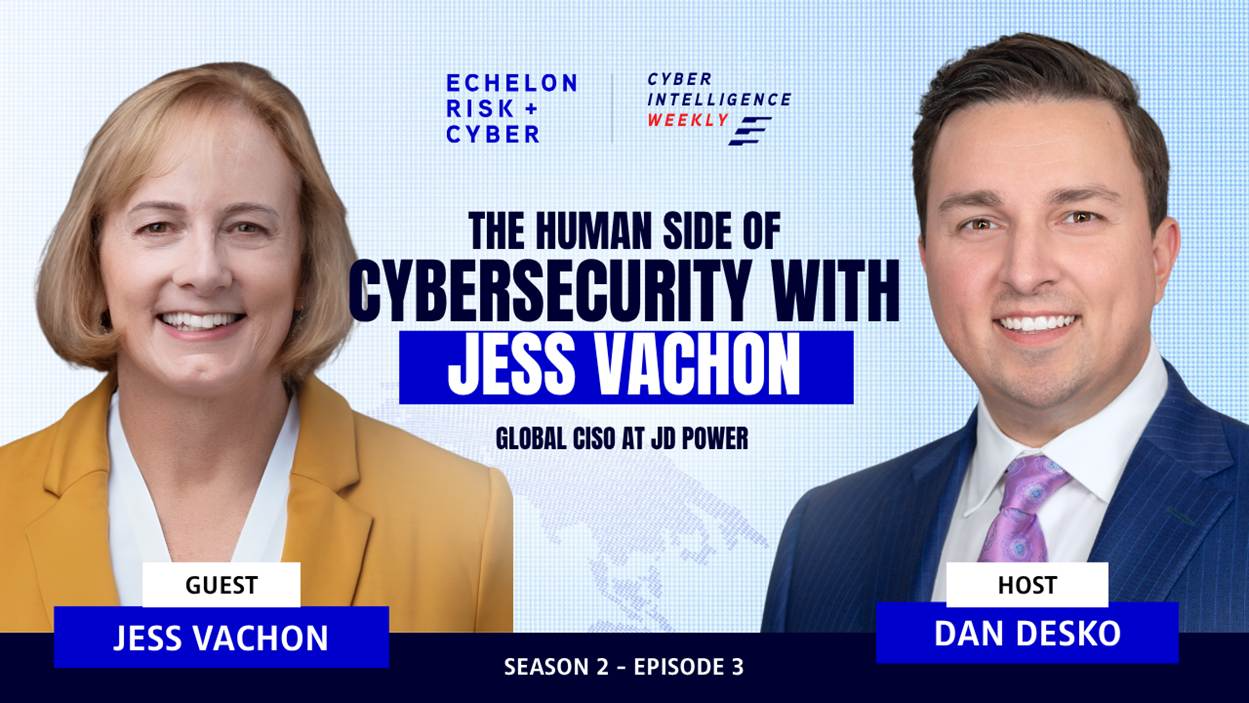
The Human Side of Cybersecurity is back for Season 2! For those new to the series, this is a podcast where I sit down with CISOs and security leaders who are in the seat, navigating real leadership pressure, complex risk decisions, and the human realities of building and sustaining security programs. What they share is experience, earned through moments of progress, frustration, growth, and reflection.
Last season, 15 conversations across industries pointed to the same truth: the human side of this work is what actually moves the needle. Season 2 goes deeper into exactly that, and we are keeping it rolling with conversations I think you'll really enjoy.
Jess Vachon (Global CISO, JD Power) — “Cybersecurity is a marathon, not a sprint.”
In this episode, I sat down with Jess Vachon, Global CISO at JD Power, a three-time CISO whose path into security started with a Commodore VIC-20, ran through the Marine Corps, Cisco Systems, Chase Paymentech, and several years in healthcare IT before landing squarely in the CISO seat. The moment she knew she’d made the right call was the day a ransomware attack hit one of her healthcare organizations, and bounced off a control her team had built just three months earlier. The device was off the network before the alert even fired.
What stood out most was how clearly Jess has thought through the communication side of this role. She tells her teams the same thing consistently: fifty percent of security work is communication. Getting other groups to understand the risk, to own it alongside you, and to act on it, that is the real job.
She also brought a grounded, honest take on AI. Her framing stuck with me: treat it as a multiplier, not a replacement. One-for-one staffing trades with AI don’t work. Giving your smartest people a more powerful tool and letting them figure out where it fits.
Additional takeaways from the conversation:
- The shift from engineer to leader requires rewiring how you communicate. Jess spent years working on her own communication skills before coaching her teams through the same shift. The brilliant engineers who dictate instead of dialogue are the ones who create friction and short careers.
- Ownership has to be shared, not assigned. Security outcomes cannot live entirely with the security team. Jess’s approach is to bring business partners into the conversation early, so they arrive at the same conclusions themselves.
- Business risk is the only language that moves executives. The math has to make sense: spending $250,000 to prevent a $10 million loss is a conversation any CFO can follow.
- AI is a multiplier, not a one-for-one replacement. Organizations that have traded headcounts for AI have largely gotten it wrong. The ones seeing results are using it to make smart people faster, not to eliminate them.
- Security as a business enabler is real, but the windows are narrow. Reducing SOC costs through AI-enhanced tooling, lowering cyber insurance exposure, and removing unnecessary authentication friction for end users, those are the moments where security creates visible business value.
- The marathon mindset is not a metaphor, it is a survival strategy. You will never reach the end of the list. You will never have enough budget to cover everything. The leaders who last are the ones who pace themselves, stay present, and keep moving forward.
Her billboard message was direct: Cybersecurity is a marathon, not a sprint. A CIO said it to her early in her career, and it changed how she pursued everything. The work never ends, the threats never stop, the answer is not to sprint harder, it is to think like a marathoner and keep showing up.
If there was one thread that ran through this conversation, it was this: the security leaders who earn lasting influence are the ones who learn to communicate, build shared ownership, and pace themselves well enough to still be in the room when it matters most.
Watch the Full Interview Here: Human Side of Cybersecurity | Linktree
Echelon Events & Thought Leadership Highlight
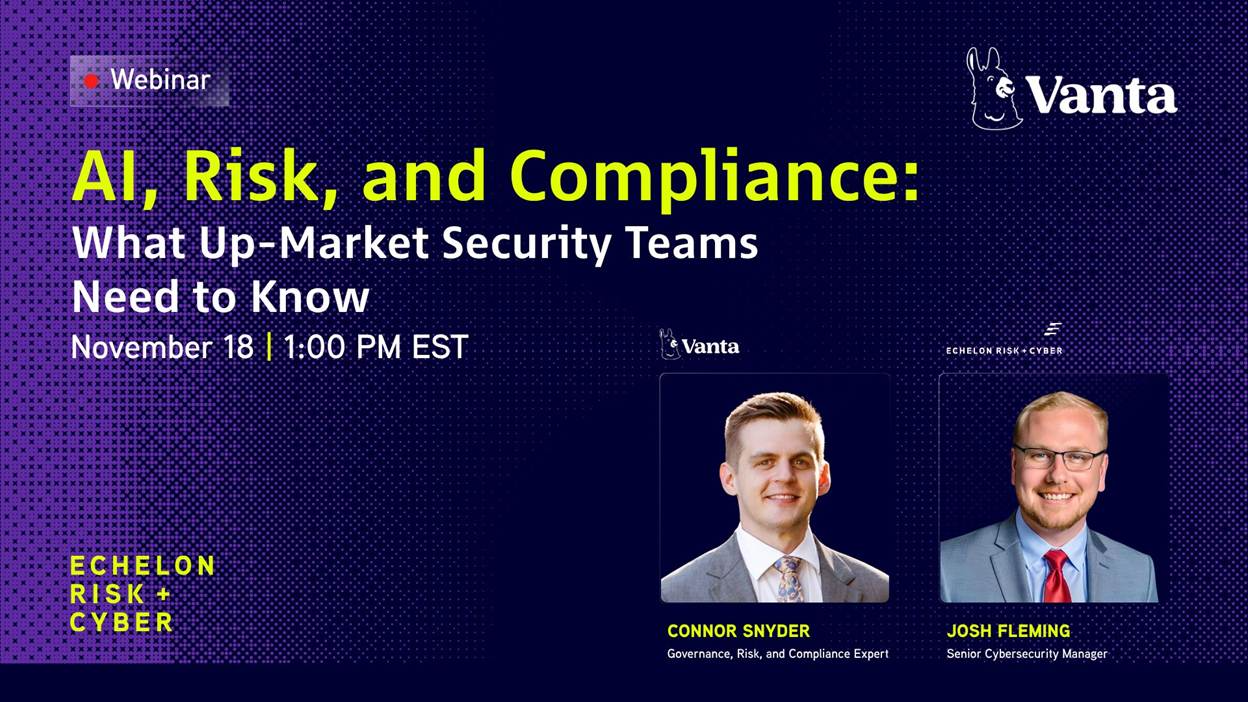
AI is being adopted across almost every organization. In many cases, leadership teams want to move even faster with it.
But there's a problem with that. Most security and compliance programs weren’t built for AI.
On November 18, join our very own @Josh Fleming along with @Vanta's @Connor Snyder, CPA, CISA to talk about what security leaders can do about it.
Save your spot: https://lnkd.in/eUs9iaq5
Away we go!
1. NSA Warns Millions of Websites Could Be at Risk From Critical PHP Vulnerabilities
This past week, the National Security Agency had issued an urgent cybersecurity warning over two critical vulnerabilities in PHP, the programming language that powers a substantial portion of the world's websites. The flaws, tracked as CVE-2026-109618 and CVE-2026-109619 and collectively known as PHP2Shell, could allow attackers to remotely execute malicious code on vulnerable web servers without needing a username or password. In an October 21 advisory, the NSA urged organizations to identify affected systems and install security updates immediately, warning that systems unable to be patched may need to be temporarily taken offline. The vulnerabilities have also prompted alerts from cybersecurity agencies around the world, reflecting concerns about their potentially widespread impact.
Unlike vulnerabilities found in a specific website plugin or application, PHP2Shell affects the underlying PHP software used to process web requests. That distinction matters because organizations running platforms such as WordPress, Drupal or custom PHP applications could remain exposed even if their website software and plugins are fully updated. An attacker who successfully exploits a vulnerable server could potentially steal sensitive information, disrupt online services or use the compromised system to move deeper into an organization's network. Imagine a healthcare provider operating a patient portal or a retailer processing customer orders through a PHP-based application. A successful attack could jeopardize sensitive records, interrupt business operations and create a pathway into other connected systems. The NSA emphasized that these flaws are serious enough to warrant immediate attention across federal government environments.
The PHP development team released security updates on October 21 addressing both vulnerabilities. Organizations should upgrade to PHP 8.5.12, 8.4.27, 8.3.36 or 8.2.35, depending on their current supported version. Older installations, particularly those running PHP 8.1 or earlier, may require migration to a supported release or a verified vendor-provided fix. Security teams should inventory internet-facing websites, application servers, containers and third-party products that rely on PHP, including systems where the underlying technology may not be immediately obvious. The NSA also recommends enhanced logging and monitoring while patches are deployed. Where immediate remediation is not possible, organizations should consider isolating affected applications or taking vulnerable systems offline until they can be secured.
The warning comes amid growing concern that attackers will move quickly to exploit PHP2Shell. AWS threat intelligence reported detecting an attempted exploit several days before public disclosure, and researchers have observed a surge in attack attempts since the vulnerabilities became known. For business leaders, the message is straightforward: a website does not have to be visibly compromised to represent a serious security risk. Organizations should verify the PHP versions running behind their public-facing services, coordinate with hosting providers and confirm that patches have actually been applied. When the software powering a website can be exploited without authentication, waiting for evidence of an attack is not a sound security strategy.

PHP2Shell Vulnerabilities Put Cloud-Hosted Websites at Risk
Two newly disclosed vulnerabilities in PHP are raising concerns for organizations running web applications in AWS, Microsoft Azure, Google Cloud and other hosting environments. The vulnerabilities, tracked as CVE-2026-109618 and CVE-2026-109619 and collectively called PHP2Shell, could allow attackers to compromise vulnerable PHP applications and potentially execute malicious code on the underlying server. The flaws were publicly disclosed on October 21, but AWS threat intelligence reportedly observed an exploitation attempt as early as October 17. Researchers have since identified additional attack activity, underscoring how quickly attackers move when widely deployed software is affected.
The exposure is especially significant because PHP remains common in business websites, customer portals and web applications. Consider an organization running a PHP-based customer portal on a cloud virtual machine or inside a container. If the application is vulnerable and publicly accessible, an attacker could potentially exploit the underlying PHP weakness to gain access to the server, steal application secrets or interfere with the service. Cloud hosting does not automatically protect applications from vulnerabilities in the software they run. Even organizations using managed infrastructure remain responsible for maintaining their application runtimes, dependencies and deployment images.
Security teams should prioritize updating affected PHP installations using the latest security releases from the PHP project. Google Cloud has also published defensive guidance for customers using Cloud Armor. Organizations with Cloud Armor managed rules already enabled receive updated protections automatically. Customers without those protections should consider enabling the recommended File Upload and Remote File Inclusion rule categories. These web application firewall protections can help reduce exposure while administrators identify and patch vulnerable systems, but they should not be treated as substitutes for updating PHP. Organizations should also rebuild affected container images, redeploy workloads, restart PHP processes and review web application logs for suspicious activity.
The practical lesson is that cloud vulnerability management must extend beyond operating systems and infrastructure services. Application runtimes, container images and third-party dependencies can expose cloud workloads even when the underlying infrastructure is properly secured. Organizations should maintain an inventory of PHP applications, automate runtime updates where possible and verify that security controls are effective across development, staging and production environments. A cloud application is only as secure as the software running inside it, regardless of which provider hosts the infrastructure.

2. Critical GitLab Vulnerability Could Give Hackers Control of Corporate Source Code Servers
GitLab has released an emergency security update addressing a maximum-severity vulnerability that could allow attackers to take complete control of self-managed GitLab servers without authentication. The flaw, tracked as CVE-2026-110264, carries a CVSS score of 10.0 and affects GitLab Community Edition (CE) and Enterprise Edition (EE) installations dating back to version 7.0. Disclosed on October 21, the vulnerability involves an integer overflow in Onigmo, a regular expression processing component, that can be triggered by specially crafted input. Successful exploitation could allow an attacker to execute arbitrary code on the underlying server without needing a username or password. GitLab has already secured its hosted GitLab.com service, but organizations operating their own installations must take action to protect their environments.
The potential consequences extend well beyond the compromise of a single server. GitLab is commonly used to store proprietary source code, manage software development projects and automate the processes that build and deploy applications. A successful attack could potentially expose confidential code, compromise development credentials or allow malicious changes to enter an organization's software delivery pipeline. Imagine a technology company using a self-hosted GitLab instance to manage its customer-facing applications. An attacker who gains control of that server could potentially access sensitive repositories, interfere with automated deployments or steal credentials that provide access to additional systems. For organizations that rely heavily on continuous integration and continuous delivery, a compromised GitLab environment could become a stepping stone to a much larger supply chain incident.
The emergency release addresses 12 vulnerabilities, including two additional high-severity issues. One, tracked as CVE-2026-15723, involves LDAP injection that could allow attackers to take over accounts authenticated through LDAP. Another, CVE-2026-112212, involves HTTP request and response smuggling that could redirect certain application traffic to an attacker-controlled server. GitLab has released fixes in versions 19.5.1, 19.4.3 and 19.3.6, along with additional backported patches for older releases. This is the second maximum-severity GitLab vulnerability addressed in October, highlighting the urgency for organizations that maintain their own installations. GitLab is urging affected customers to upgrade as soon as possible rather than wait for their normal maintenance schedules.
Organizations running self-managed GitLab should immediately identify affected instances, apply the latest supported security release and verify that the updates have been successfully installed. Security teams should pay particular attention to internet-facing installations, review authentication and administrative activity, and investigate unexpected changes to repositories, CI/CD pipelines and access credentials. Restricting network access, enforcing multifactor authentication and limiting the permissions of automation tokens can provide additional protection, although these measures do not replace patching a vulnerability that can be exploited without authentication. The larger lesson is that software development platforms have become critical security infrastructure. When attackers gain control of the systems responsible for building and deploying software, the potential impact can extend to every application and customer that depends on them.

FastMCP Vulnerability Could Expose Credentials Used by AI Agents
A newly published security advisory highlights a credential-exposure vulnerability in FastMCP, an open-source framework used to connect AI applications and autonomous agents to external tools and services through the Model Context Protocol (MCP). The vulnerability, tracked as GHSA-vqqp-x5qm-5qp4, affects certain machine-to-machine OAuth authentication configurations in FastMCP versions 4.0.0 through 4.1.1. Under specific conditions, an attacker controlling or compromising an MCP server could redirect an AI application's authentication request to a malicious authorization server, potentially capturing the client credentials used to access legitimate services.
The issue involves how FastMCP handles OAuth authorization-server information. An affected client may accept an authorization server advertised by the MCP server without verifying that it is the trusted issuer associated with its credentials. Consider an organization deploying an AI assistant that connects to internal business applications through MCP. If the assistant connects to a compromised or attacker-controlled MCP server, the malicious server could direct authentication to an endpoint controlled by the attacker. The resulting credential exposure could allow the attacker to impersonate the application when accessing legitimate services, depending on the permissions and protections associated with those credentials.
FastMCP 4.1.2 includes a security fix, but upgrading alone is not sufficient. Developers must also explicitly configure the trusted OAuth issuer for affected authentication providers so credentials are bound to the intended authorization server. Organizations using FastMCP should inventory their MCP integrations, update affected fastmcp and fastmcp-slim installations to version 4.1.2 or later, validate trusted server endpoints and rotate credentials that may have been exposed. Security teams should pay particular attention to AI applications that connect to third-party MCP servers, accept user-supplied server addresses or use machine-to-machine credentials with broad permissions.
The broader concern is that AI agents are increasingly being given access to sensitive enterprise systems, often through integrations that operate without continuous human involvement. That makes authentication and authorization controls especially important. Organizations should establish approved MCP server inventories, enforce least-privilege permissions, protect service credentials and monitor connections to unfamiliar authorization endpoints. An AI agent with access to critical business systems should never be allowed to trust a new authentication destination simply because another server tells it to.

3. Chinese Hackers Use AI Agents to Target More Than 2,250 Microsoft 365 Environments
A Chinese state-aligned hacking group has demonstrated how quickly artificial intelligence is changing the speed and scale of cyberattacks. According to Microsoft Threat Intelligence, the group known as Storm-0940 used an AI-powered penetration testing framework called ARTEX to launch attacks against more than 2,250 Microsoft 365 environments following a compromise involving ConnectWise Cloud Backup. The attackers used stolen application credentials to attempt thousands of cloud sign-ins, reaching speeds of approximately 2,900 attempts per minute. In several cases, the group obtained privileged access to corporate cloud environments in less than three hours. Microsoft emphasized that the activity did not involve a vulnerability in Microsoft 365 itself, but rather the abuse of trusted third-party application access.
The attack began with compromised credentials associated with ConnectWise cloud applications, which already had permission to interact with customers' Microsoft 365 environments. Rather than stealing individual employee passwords, the attackers exploited those existing relationships to authenticate through applications that organizations had previously authorized. ARTEX, an open-source agentic AI framework, helped automate reconnaissance, credential attacks and attempts to abuse OAuth permissions. Once inside certain environments, the attackers used Microsoft Graph to examine cloud resources, modify application credentials and attempt changes to privileged identities and roles. Some of these changes could provide persistent access even after the original compromised application was secured. Microsoft reported that most targeting attempts were unsuccessful, and the 2,250 environments represent attempted access rather than confirmed breaches.
Storm-0940 has been active since at least 2021 and has targeted organizations across industries including aerospace, defense, financial services, government, manufacturing and technology. What distinguishes this campaign is the degree of automation involved. Activities that previously required attackers to manually investigate systems, test credentials and move through an environment can increasingly be coordinated by AI agents operating with limited human involvement. For security teams, that dramatically compresses the time available to recognize suspicious behavior and respond. An attack that progresses from initial access to privileged control in a matter of hours leaves little room for traditional security processes that depend on analysts manually reviewing alerts and approving containment actions.
For organizations using Microsoft 365, the incident is a reminder that third-party applications can represent some of the most powerful identities in a cloud environment. Security teams should review enterprise applications and service principals in Microsoft Entra ID, validate OAuth permissions, remove unnecessary access and monitor for unusual application sign-ins or changes to privileged roles. Organizations using affected ConnectWise services should follow Microsoft's and ConnectWise's specific containment and restoration guidance, including keeping affected connections disabled until cleared for restoration. Automated detection and containment are also becoming increasingly important as attackers adopt AI-driven tools capable of operating at machine speed. The lesson is not simply that hackers are using AI. It is that organizations must secure and monitor the trusted applications that can act on their behalf, because those identities may provide attackers with access that ordinary employee accounts never could.
Thanks for reading!
About us: Echelon is a full-service cybersecurity consultancy that offers wholistic cybersecurity program building through vCISO or more specific solutions like penetration testing, red teaming, security engineering, cybersecurity compliance, and much more! Learn more about Echelon here: https://echeloncyber.com/about