
Welcome to our weekly newsletter where we share some of the major developments on the future of cybersecurity that you need to know about. Make sure to follow my LinkedIn page as well as Echelon’s LinkedIn page to receive updates on the future of cybersecurity!
To receive these and other curated updates to your inbox on a regular basis, please sign up for our email list here: https://echeloncyber.com/ciw-subscribe
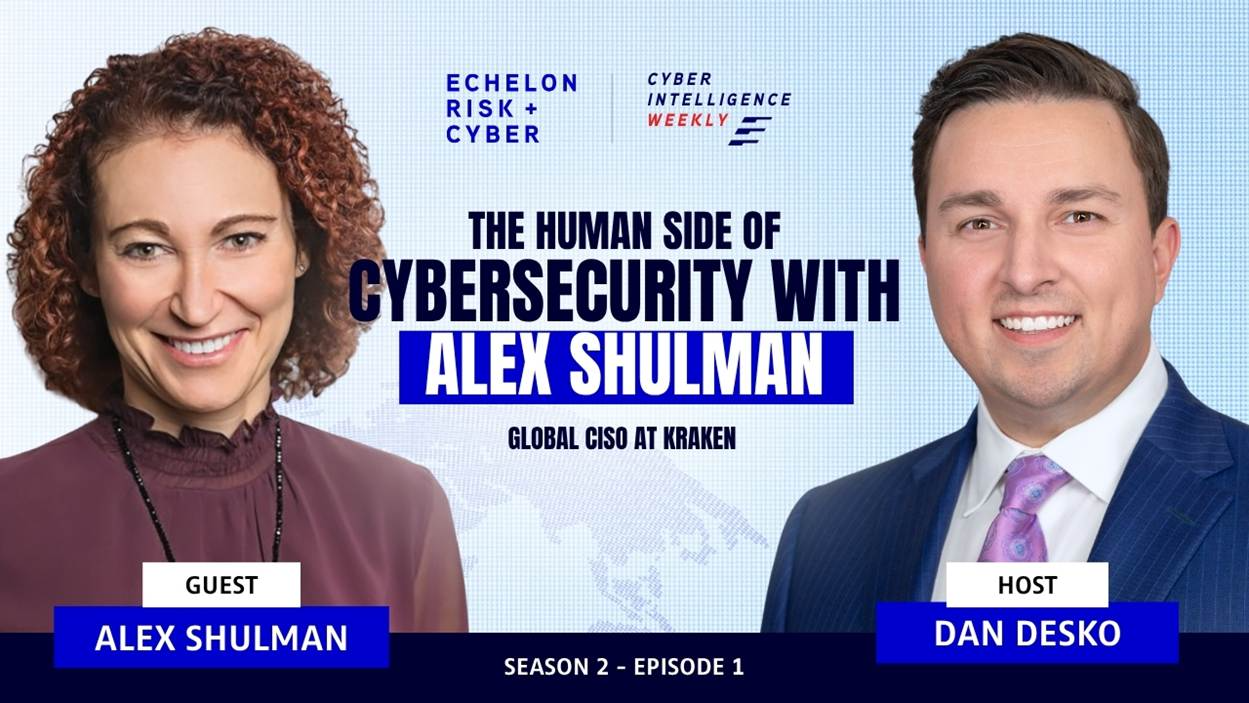
The Human Side of Cybersecurity Before we turn to this week's edition of Cyber Intelligence Weekly, I want to share something I've been building toward for a while.
The Human Side of Cybersecurity is back for Season 2, and the first episode is live today. For those new to the series, this is a podcast where I sit down with CISOs and security leaders who are in the seat, navigating real leadership pressure, complex risk decisions, and the human realities of building and sustaining security programs. What they share is experience, earned through moments of progress, frustration, growth, and reflection.
Last season, 15 conversations across industries pointed to the same truth: the human side of this work is what actually moves the needle. Season 2 goes deeper into exactly that, and we're kicking it off with a conversation I think you'll really enjoy.
Alex Shulman (Kraken) — "You need to see around the corners."
In this episode, I sat down with Alex Shulman, Ph.D. , CISO at Kraken, to talk about what it actually takes to lead security inside one of the fastest-moving organizations in the world. Alex's path into the CISO seat reflects something I hear more and more from the best leaders in this space at some point, the job stopped being about technology and became about understanding the business, reading the geopolitical landscape, and communicating risk in language that drives real decisions.
What stood out most was how clearly Alex sees the pressure building on security teams right now. AI is changing the speed of threats, the speed of attacks, and the speed at which organizations need to respond, and the leaders who will thrive are those willing to challenge their own assumptions and build programs that can keep pace with it.
Additional takeaways from the conversation:
- Geopolitics belongs in the security conversation. Understanding the global threat landscape shapes how you prioritize and where you invest.
- AI is forcing a rethink, not just an upgrade. The playbooks organizations are running today were written for a different era. Adaptation is the competitive advantage.
- Communication is still the core skill. The most effective security leaders translate risk into business terms that actually drive decisions.
- Security is an enabler, not just a gatekeeper. The leaders who earn a seat at the table are the ones who help the business move forward, not just the ones who keep it safe.
- Burnout is a leadership problem. Building sustainable teams means protecting people from unnecessary urgency before it becomes a retention problem.
- Flexibility outlasts perfection. Programs that can adapt are more valuable than programs that are theoretically ideal but fall apart under pressure.
If there was one thread that ran through this conversation, it was this: the best security leaders do not wait for the threat to become visible. They see around the corners, and they build teams, programs, and relationships strong enough to respond when it matters.
Watch the Full Interview Here: https://youtu.be/O-BHxRGoWVQ?si=ykPvZ72SQk3R30eT
Echelon Events & Thought Leadership Highlight
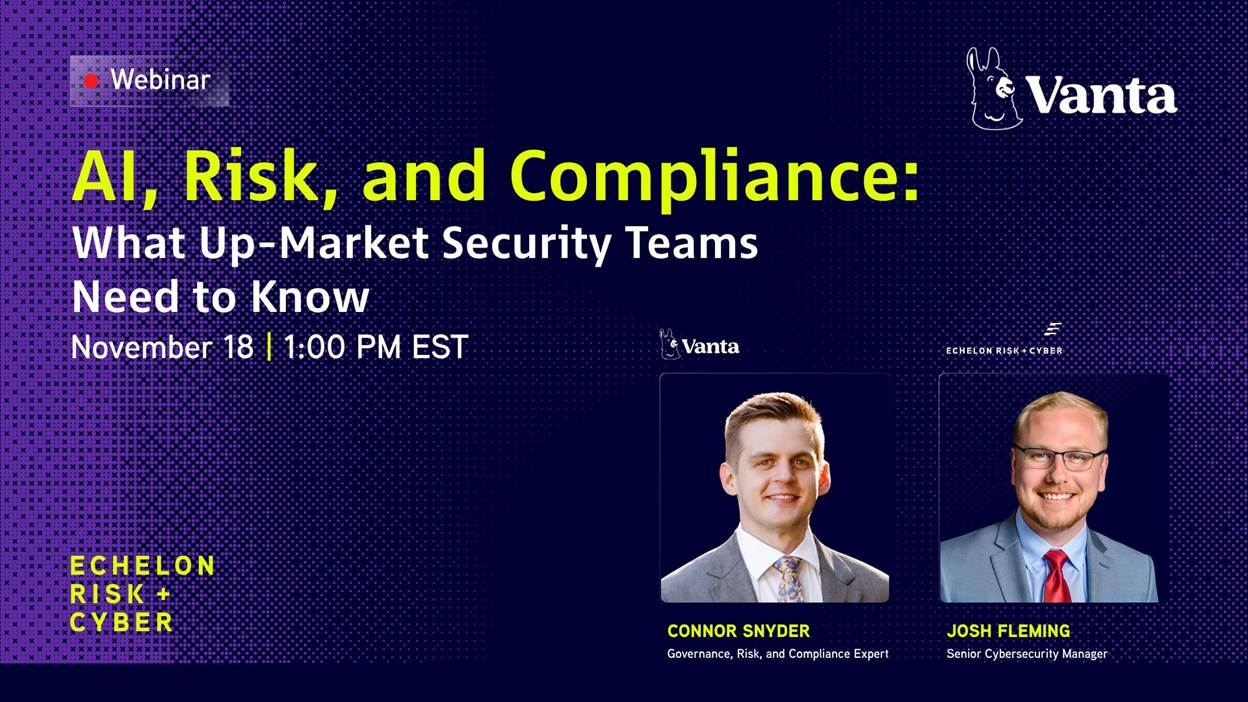
AI is being adopted across almost every organization. In many cases, leadership teams want to move even faster with it.
But there's a problem with that. Most security and compliance programs weren’t built for AI.
On November 18, join our very own Josh Fleming along with Vanta's Connor Snyder, CPA, CISA to talk about what security leaders can do about it.
Save your spot: https://lnkd.in/eUs9iaq5
Away we go!
1. FBI and Secret Service Warn of Widespread Fortinet Attacks Affecting More Than 86,000 Devices
The FBI and U.S. Secret Service are warning organizations that a widespread cyberattack campaign targeting Fortinet security appliances remains active, with some victims reportedly being locked out of their own devices. Known as FortiBleed, the operation began in June 2026 and has developed into a large-scale campaign focused on harvesting credentials and gaining unauthorized access to enterprise networks. According to security intelligence firm SOCRadar, more than 86,600 devices across 194 countries have been compromised. The campaign is especially concerning because it targets technology that organizations depend on to protect their networks, manage remote access and enforce security policies.
Unlike attacks that rely exclusively on newly discovered software vulnerabilities, FortiBleed demonstrates how effective stolen credentials and weak authentication practices can be. According to the federal advisory, attackers have exploited leaked or reused credentials and weaknesses associated with legacy SHA-256 password storage to harvest and crack authentication information at scale. Once access is established, compromised administrative accounts can give attackers significant control over affected devices, potentially allowing them to change configurations, maintain unauthorized access or prevent legitimate administrators from regaining control. Investigators also gained an unusual look inside the operation after the attackers inadvertently exposed their own backend infrastructure, revealing how they identified vulnerable targets, validated stolen credentials and expanded their access.
The FBI and Secret Service are urging Fortinet customers to take immediate defensive action. Organizations should restrict external access to device management interfaces, terminate existing administrative and VPN sessions, reset potentially compromised credentials and enforce phishing-resistant multifactor authentication across remote access and administrative accounts. Security teams should also review the indicators of compromise published in the federal advisory and investigate unusual logins, configuration changes, newly created accounts and other signs of unauthorized activity. Keeping Fortinet appliances updated remains important, but patching alone will not resolve a compromise involving stolen credentials or unauthorized administrative access. Organizations must verify that attackers have been removed and that trusted control of affected devices has been restored.
The larger lesson extends well beyond Fortinet. Firewalls, VPN gateways and other network security appliances occupy some of the most privileged positions in an enterprise environment, yet they are frequently treated as infrastructure that can be configured once and largely forgotten. That approach is increasingly dangerous. A firewall that an attacker controls is no longer protecting your network. It may be providing the attacker with a trusted pathway into it. Security leaders should ensure that management interfaces are never unnecessarily exposed to the public internet, administrative access is tightly controlled, credentials are protected with phishing-resistant MFA and appliance activity is continuously monitored. FortiBleed is another reminder that the technology defending an organization must itself be defended with equal rigor.

AWS Amplify Flaw Could Expose Other Users' Data
AWS disclosed a new vulnerability on October 9 affecting its Amplify API Category, a framework developers use to build GraphQL APIs backed by AWS AppSync. Tracked as CVE-2026-108096, the flaw involves improper authorization in automatically generated query resolvers for SQL-backed data models. Under certain conditions, an authenticated user could submit specially crafted queries and retrieve records belonging to other users of the same application. This is particularly concerning because developers may have configured ownership-based access controls and assumed the framework was enforcing them correctly.
Consider a SaaS application where customers log in to view their own account records, transactions or business documents. If the application uses an affected resolver, an authenticated customer might be able to retrieve another customer's records without possessing that customer's credentials. This is not a vulnerability that requires an attacker to compromise AWS infrastructure or obtain administrator privileges. It exploits an authorization weakness within the application itself.
AWS has released fixes, and organizations using affected Amplify packages should update immediately:
@aws-amplify/graphql-index-transformer: upgrade to 3.1.2 or later
@aws-amplify/graphql-api-construct: upgrade to 1.21.4 or later
@aws-amplify/data-construct: upgrade to 1.17.4 or later
Importantly, developers must redeploy their application backend after upgrading so the corrected resolvers are generated and deployed. AWS states that no workaround is available. Security teams should also review applications using SQL-backed GraphQL models, validate that users cannot retrieve records belonging to other accounts, and examine relevant access logs for suspicious queries.
Why it matters: Cloud security is not just about protecting infrastructure and configuring IAM policies. Application-level authorization is equally important, especially when frameworks generate security-sensitive code automatically. Organizations should routinely test whether authenticated users can access data belonging to other users or tenants. A successful login should never be confused with permission to access every record behind an API.

2. OpenAI Disrupts Russian and Iranian Influence Campaigns Using ChatGPT to Spread Propaganda
OpenAI has shut down accounts connected to Russian and Iranian influence operations that used ChatGPT to help spread political propaganda through social media, online publications and seemingly legitimate organizations. According to a new company safety report, the campaigns combined AI-generated material with traditional influence tactics, including fabricated identities, misleading research organizations and fake journalists. The operations were separate, but both demonstrated how generative AI can help foreign actors produce and distribute persuasive content while concealing who is actually behind it.
The Russian campaign focused heavily on Latin America, where operatives established a fake research organization called the Social Research Center. Publicly, the organization claimed to study the Indian diaspora and relations between India and Latin American countries. Behind the scenes, OpenAI found evidence suggesting it was controlled by Russian operatives operating through a fabricated identity. The group even recruited local researchers who apparently had no idea they were contributing to a Russian influence operation. While much of the organization's published research was produced by those employees, its operators used ChatGPT to develop fake leaked documents, audio scripts and other materials intended primarily to damage Ukraine's reputation. Some of the resulting claims circulated widely enough to draw fact-checks and official denials.
The Iranian operation took a different approach, creating seven fake journalist identities to place articles about the U.S.-Iran conflict in online publications. OpenAI identified nearly 100 articles published or republished under those identities across roughly a dozen outlets, including some with sizable audiences. The operators used ChatGPT to refine articles, prepare pitches to editors, generate internal reports and produce social media comments in English and Persian. Although the social media posts attracted relatively little engagement, the publication strategy was more consequential. Instead of relying exclusively on fake accounts to attract followers, the operators used established media outlets to give their messaging the appearance of independent journalism. OpenAI has banned accounts associated with both campaigns, but the report illustrates how difficult it can be to distinguish authentic reporting from carefully coordinated influence activity.
For organizations, the cybersecurity implications extend beyond politics. These campaigns show how attackers can use AI to strengthen social engineering, impersonation and disinformation efforts without necessarily developing sophisticated new technical capabilities. A fabricated research institution, convincing journalist identity or seemingly credible report could just as easily be used to approach executives, solicit sensitive information or manipulate business decisions. Security awareness programs need to account for these tactics, particularly when employees are contacted by unfamiliar researchers, journalists or organizations requesting information. The real danger is not simply that AI can generate convincing content. It is that AI can help malicious actors build the appearance of credibility around that content, making deception harder to recognize before someone acts on it.

AWS AI Coding Agent Plugin Vulnerability Could Allow Command Execution
AWS disclosed a vulnerability on October 8 in its open-source Amazon Agent Plugins for AWS, a collection of plugins that extend AI coding assistants with AWS-specific capabilities. The issue, CVE-2026-107322, affects the databases-on-aws plugin, which helps developers design, manage and interact with AWS databases. Researchers discovered that incomplete input validation could allow specially crafted content to influence an AI agent into executing operating-system commands through a local database helper script.
The attack illustrates a growing concern with agentic AI. Imagine a developer using an AI assistant to configure an Aurora DSQL database. The assistant encounters malicious content containing a crafted database command value. If the agent subsequently passes that value into the vulnerable helper, the command could execute on the developer's machine or wherever the helper is running. The attacker does not need to authenticate to the helper itself, although successful exploitation depends on the agent ingesting the content and invoking the affected command path. AWS emphasizes that the vulnerability does not directly affect the Aurora DSQL service or bypass database permissions.
The fix is available in databases-on-aws version 1.7.1 or later. Organizations should update the plugin and verify that the corrected version is actually active in every environment where it is installed. For teams pinning plugins to specific Git revisions, AWS recommends commit 8b13a503746a4ebb0402b936645163224058bde3 or later. Until upgrading, developers should avoid the optional psql connection helper, use manually reviewed SQL or the plugin's DSQL MCP server, and run agents under unprivileged operating-system accounts with narrowly scoped AWS IAM and database permissions. Organizations that suspect compromise should also review and rotate potentially exposed credentials.
Why it matters: AI coding agents are becoming powerful extensions of developer environments, often with access to source code, cloud credentials, databases and command-line tools. That makes every plugin and helper script part of the enterprise attack surface. Security teams need to inventory installed agents and plugins, control which tools agents can invoke, monitor command execution and enforce least privilege. The fundamental rule is simple: untrusted content should never be allowed to become an operating-system command simply because an AI agent decided to use it.

3. Some Android Phones Are Arriving with Malware Already Installed
Buying a brand-new smartphone usually comes with a reasonable expectation that the device is clean, secure and ready to use. But researchers at Bitdefender have uncovered a malware campaign that turns that assumption on its head. Certain inexpensive Android smartphones built on MediaTek platforms have reportedly been shipping with malicious software already embedded in their firmware. The campaign, which researchers call Midnight Mimosa, gives attackers a foothold before the customer ever powers on the device. Unlike traditional mobile malware that relies on users downloading a malicious application or clicking a suspicious link, this threat is built into the software that arrives with the phone.
The malware operates with system-level privileges, giving it capabilities far beyond those of an ordinary Android application. According to Bitdefender, the malicious component can silently install and remove apps, grant permissions and execute additional code supplied remotely. Researchers identified a rotating collection of at least 32 disguised applications used primarily to generate fraudulent advertising revenue through automated interactions and click activity. They also discovered 13 applications available on Google Play that communicated with the same infrastructure controlling the preinstalled malware. The findings suggest an operation that extends beyond a handful of infected phones, using multiple distribution channels to support a coordinated advertising fraud scheme.
What makes this campaign particularly concerning is where the compromise occurs. The malicious software is embedded in firmware as a platform-signed system component, allowing it to operate with permissions that typical apps cannot obtain. That creates a problem traditional mobile security advice cannot easily solve. Users can avoid suspicious downloads, scrutinize app permissions and install security updates, yet still find themselves using a device that was compromised somewhere along the manufacturing or software distribution process. Researchers have not established exactly where the malicious component entered the supply chain, leaving open questions about the roles of device manufacturers, firmware suppliers and other parties involved in preparing the software installed on these phones.
For businesses, the findings reinforce the importance of treating mobile device procurement as a cybersecurity decision rather than simply a purchasing exercise. Organizations allowing inexpensive or unfamiliar Android devices to access corporate email, cloud applications and sensitive information should reconsider whether those devices meet their security requirements. Enterprise mobility programs should establish approved device models and purchasing channels, enforce mobile device management policies, verify operating system integrity where supported and restrict access from devices that cannot demonstrate an acceptable security posture. A factory reset cannot be relied upon to remove malware embedded in trusted firmware. The broader lesson is that cybersecurity begins well before an employee signs into a corporate application. If the device itself cannot be trusted, the applications and information running on it may already be at risk.
Thanks for reading!
About us: Echelon is a full-service cybersecurity consultancy that offers wholistic cybersecurity program building through vCISO or more specific solutions like penetration testing, red teaming, security engineering, cybersecurity compliance, and much more! Learn more about Echelon here: https://echeloncyber.com/about